


Building a Benagentic Community
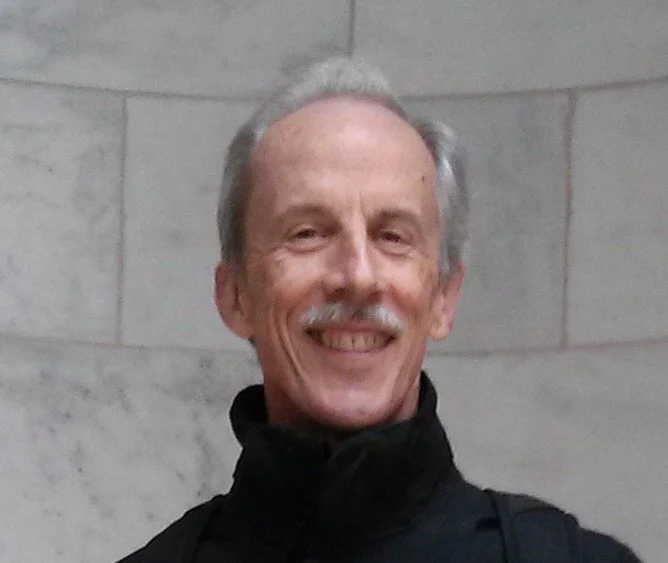
AC Wilkinson
Colorful career, partly academic, always learning.
Peace-lover at heart, change-maker at times.
Pro bono for good.
How I got here …
Officially, my education culminated in a PhD in scientific psychology, the sort that values experiments, statistics, and math, not counseling or therapy. Among my more rewarding eperiences in graduate school was a course in cognitive science where I did some recursive programming in Lisp. So much fun! And I got an A+. But more important, I learned that sound research requires a good question, and that answers, even if highly probable, are never certain.
For several years, I published research as a Big Ten professor, coding my own programs on a bleeding-edge Apple II computer (pitiful by today's standards) in order to solve non-linear equations for mathematical models of children's cognition. Alas, my published articles, like many from the ivory towers, appealed to a limited audience. I may have taken more pride in my best marathon (Boston, 2:49) than in my scholarship.
Diverging from university life, I re-launched myself as a self-taught software engineer at what was then a technical hothouse, Bell Labs. There, answers to the questions that dominated my work-life were framed, literally, as U.S. patents. Yet after two decades of that, I boomeranged to academia, driven in no small part by the financial turmoil of the millenium. It doomed many telecom employers, including mine. Happily, I found an intellectual home at an upstate university, teaching courses in fields whose questions were almost as new to me as to my students: wireless networks, security protocols, information privacy.
New questions, unrelated to my work or formal education, began to engage me during those years. How can I most sensibly save for my child's education and, at the same time, invest for my retirement? That expensive mortgage on that lovely home, was it a good idea? Will my family survive the next financial calamity? I sought answers by studying economics, market histories, and financial planning. With real dollars, I learned sobering lessons about estimating likelihoods and applying them to personal decisions — and about being data-driven even when the evidence has, well, a mind of its own.
Eventually, yearning for a phase-shift in my career, I remembered my youthful activism. Before becoming an academic, I was a proud veteran of the civil rights and peace movements and a union organizer. I decided to leave the ivory towers again, this time to work for non-profits. By consulting on technology, data, and software, I helped my non-profit clients to quantify and strengthen their programs. My clients were diverse; their dedication, inspiring. Among them were community agencies in Harlem; managers of food banks; attorneys for the poor and powerless. And, especially, survivors of human trafficking and their advocates, on whose behalf I dedicated all my working hours, pro bono, for more than a dozen eventful years.
Looking ahead to my next decade, still seeking good answers to worthy questions, my gaze is locked now on a technological community that embraces so much of what captivated me in the past. This vision, Benagence, sees the vast potential for good in the new AI and its massively recursive data — a spacetraveler compared to the tricycle of my LISP programs and Apple II. Like the little, chip-smart, lightly coached robots that bootstrap themselves on an intelligent neural network to play a decent game of soccer, let’s figure out how to use AI for everything good (and nothing but good).